Artificial Intelligence (AI) is transforming how businesses operate, automate tasks, analyze information, and interact with customers. From intelligent chatbots to AI-powered document search systems, modern applications increasingly use AI technologies to solve real-world problems. One of the key technologies driving this transformation is the Large Language Model (LLM). For students, fresh graduates, and aspiring developers, learning how to build applications using AI and LLMs can be a valuable step toward developing practical technology skills. However, understanding concepts alone is not always enough. Hands-on experience helps learners understand how AI applications are designed, developed, tested, and improved.
This is where AI and LLM training with live projects can make a difference. With a structured learning plan, consistent practice, and guided project development, learners can work toward building functional AI applications within a three-month training period.
At ToXSL Technologies, practical training with live projects provides an opportunity for learners to connect technical concepts with application development and explore how AI can be used to address real-world challenges.
What Is Artificial Intelligence and LLM Training?
Artificial Intelligence is a broad field of computer science focused on developing systems that perform tasks associated with intelligent behaviour. These tasks may include recognizing patterns, processing language, making predictions, and generating content. Large Language Models are a category of AI models designed to process and generate human language. They can be integrated into applications that support conversational interactions, text summarization, document analysis, and information retrieval. AI and LLM training introduces learners to the concepts, tools, and development techniques used to build these applications. Learning these concepts through guided exercises and project work can help students understand how different technologies work together in a functional application.
Depending on the curriculum, a practical training program may cover:
Fundamentals of Artificial Intelligence and Generative AI
Python programming for AI development
Understanding Large Language Models
Prompt engineering and structured prompting
Working with LLM APIs
Embeddings and semantic search
Retrieval-Augmented Generation (RAG)
AI chatbot and assistant development
Why Choose AI and LLM Training with Live Projects?
Understanding AI concepts is an important first step, but applying them to practical problems helps learners develop a deeper understanding of the technology. Industrial training in AI and LLM development with a live-project-based learning approach provides learners with opportunities to experiment with AI tools, write application code, troubleshoot technical errors, and improve software functionality. This practical industrial training experience helps bridge the gap between theoretical knowledge and real-world application development while strengthening technical skills, problem-solving abilities, and an understanding of industry-oriented development practices.
1. Apply Theoretical Knowledge in Practice
Practical projects allow learners to use the concepts they study. For example, after learning about LLMs, a student might develop a chatbot that answers user questions through an integrated language model. This process introduces the steps involved in connecting an AI model to a software application and presenting its output to users.
2. Develop Technical Problem-Solving Skills
AI development involves more than generating responses from a model. Developers must consider input quality, response accuracy, application performance, error handling, and user experience. Working on projects helps learners understand these challenges and practise finding suitable solutions.
3. Gain Experience with AI Development Tools
Depending on the curriculum, learners may work with Python, APIs, AI frameworks, databases, and development environments. Using these tools in practical exercises helps learners understand their roles in the AI application development process.
4. Build Projects That Demonstrate Your Skills
A completed project can demonstrate how a learner has applied technical concepts to a specific problem. Project documentation, code samples, and demonstrations may also be useful when presenting skills to potential employers or clients. Learners should ensure that any work they share is their own and that they have permission to publish it.
5. Understand How AI Is Used in Business Applications
AI technologies are used in applications such as customer support assistants, document processing tools, knowledge management systems, and intelligent search platforms. Building similar projects can help learners explore practical use cases and understand how AI can be integrated into software products.
What Skills Can You Learn Through AI and LLM Training?
A structured AI training program can introduce learners to several important concepts used in modern AI application development. The exact skills depend on the course curriculum, but the following areas are relevant to learners interested in building LLM-powered applications.
1. Python Programming
Python is widely used in AI development because of its libraries and integration capabilities. Programming fundamentals help learners understand application logic, process data, work with APIs, and connect different software components. Beginners with limited programming experience may need to strengthen their Python knowledge before progressing to more advanced projects.
2. Generative AI Fundamentals
Generative AI refers to AI systems that can generate content, including text, images, audio, and other outputs. Learners can explore how generative models work and how they are used in modern applications.
3. Large Language Models
LLM training introduces the capabilities and limitations of language models. Learners can explore how models process prompts, generate responses, and support tasks such as question answering, summarization, and content generation.
4. Prompt Engineering
Prompt engineering involves designing instructions and providing context to guide a language model toward a useful output. Through practical exercises, learners can compare prompts, experiment with different instructions, and evaluate how changes affect model responses.
5. API Integration
APIs allow software applications to communicate with external services, including hosted language models. Learners can explore how to send requests, receive model outputs, manage errors, and integrate AI functionality into an application.
6. Embeddings and Semantic Search
Embeddings represent information as numerical vectors that capture aspects of its meaning. They can be used to identify semantically related content and support search systems that go beyond exact keyword matching.
7. Retrieval-Augmented Generation (RAG)
RAG combines information retrieval with language generation. An application retrieves relevant information from a knowledge source and provides it to an LLM as context for generating a response. This technique is useful for applications that need to answer questions using a specific collection of documents or other reference material.
What Projects Can Beginners Build During AI and LLM Training?
Project development is an important part of learning how AI technologies work in practice. With a structured learning plan, beginners can work toward building small, functional applications. The time required depends on previous programming experience, project complexity, available practice time, and the technologies covered in the course. Here are five project ideas for aspiring AI developers.
1. AI Chatbot Development
An AI chatbot allows users to interact with an application using natural language. It can answer questions, provide information, or assist with common tasks. A beginner project may include:
A simple chat interface
Integration with an LLM API
Prompt design and response generation
Basic conversation context
Error handling and response testing
For example, learners could build a chatbot that answers frequently asked questions about a product or service.
2. Document Question-Answering System
A document question-answering system allows users to ask questions about a collection of documents. Using RAG, the application can retrieve relevant sections from documents and provide them to an LLM to generate a contextual response. A project may involve document processing, text chunking, embeddings, retrieval, and response generation. This type of application demonstrates how AI can help users find information without manually reading every document.
3. AI Text Summarization Tool
An AI summarization tool converts lengthy text into a shorter version that highlights the main points. Learners can build a simple application that accepts text and generates summaries in different formats, such as bullet points or short paragraphs. This project introduces prompt engineering, text processing, input limitations, and the evaluation of generated content.
4. Semantic Search Application
A semantic search application helps users find information based on meaning and contextual similarity. For example, a learner could develop a search tool for educational materials that identifies relevant documents even when a user's question does not contain the exact words used in the source text. The project can introduce embeddings, similarity search, vector databases, and information retrieval.
5. AI-Powered Customer Support Assistant
A customer support assistant can help users find answers to common questions about products, services, or processes. It may combine an LLM with an FAQ collection or knowledge base to provide context-aware responses. Learners can explore how to retrieve relevant information, generate helpful answers, and handle questions when sufficient information is unavailable. These are example projects rather than a guaranteed list of projects offered in a specific training program. Learners should review the course curriculum to understand which projects are included.
Who Should Consider AI and LLM Training?
AI and LLM training can be relevant to learners who want to explore modern AI technologies and develop practical software skills.
1. Students Pursuing B.Tech, BCA, or MCA: Students studying computer science or related subjects can use practical training to explore AI application development alongside their academic coursework.
2. Fresh Graduates: Graduates interested in AI technologies can use structured learning to strengthen their technical knowledge and develop projects that demonstrate their skills.
3. Aspiring Software Developers: Developers who want to expand their skill sets can explore how LLMs are integrated into software applications, intelligent search systems, and automation workflows.
4. Beginners Interested in Generative AI
Beginners can start with foundational concepts and gradually progress toward application development. Some programming knowledge is helpful for development-focused training, although prerequisites vary between courses.
How to Choose the Right AI and LLM Training Program
Choosing a training program involves more than comparing course duration or fees. Students should evaluate what they will learn, how they will practise their skills, and what support is available during project development.Consider the following factors before enrolling.
- Curriculum and course content: Check whether the course covers the AI and LLM technologies you want to learn.
- Practical project work: Ask which applications you will build and whether projects are part of the structured training process.
- Trainer guidance: Understand how trainers support learners when they encounter coding errors or technical challenges.
- Tools and technologies: Review the programming languages, APIs, frameworks, and other tools included in the course.
- Project feedback: Find out whether you will receive guidance on testing, debugging, and improving your work.
- Training duration: Ensure the schedule provides sufficient time to understand concepts and practise application development.
- Fees and learning value: Compare the fee with the curriculum, trainer support, project opportunities, and learning outcomes offered.
AI and LLM Training at ToXSL Technologies
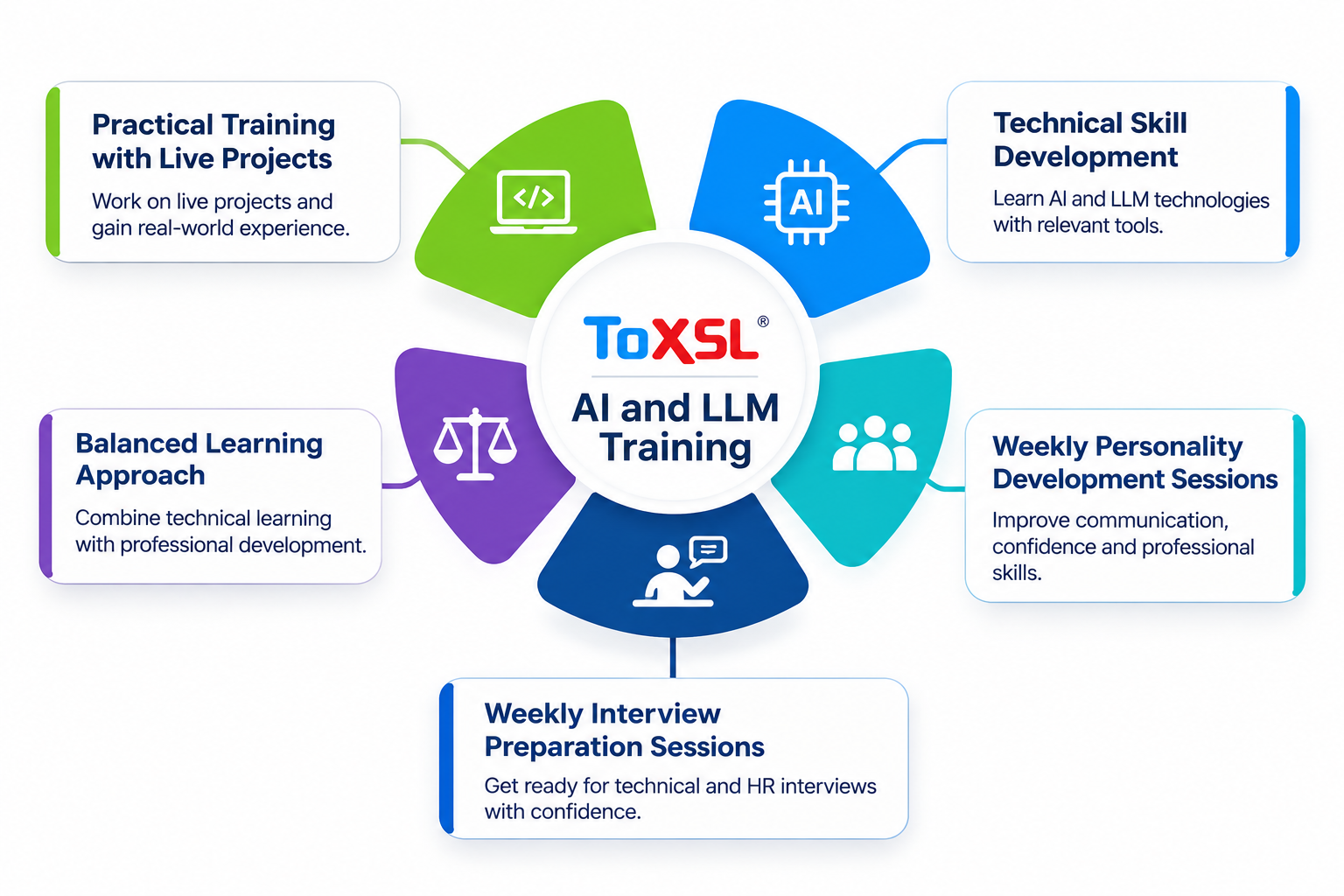
At ToXSL Technologies, we focus on developing technical knowledge alongside essential professional skills. Our training approach combines practical project experience with structured learning and additional development sessions.
1. Practical Training with Live Projects
Learners get opportunities to work on live projects and understand how technical concepts are applied during application development. This approach helps them gain exposure to coding, testing, implementation, and problem-solving.
2. Technical Skill Development
The training focuses on building an understanding of AI and LLM technologies, along with relevant development concepts and tools. Learners get an opportunity to explore how these technologies can be used to develop AI-powered applications.
3. Weekly Personality Development Sessions
Technical knowledge is important, but professional communication and confidence also play an essential role in career development. To support overall growth, we conduct weekly personality development sessions covering areas such as:
Communication and interpersonal skills
Confidence building and professional behaviour
Presentation and speaking skills
Workplace communication
Professional attitude and personal development
4. Weekly Interview Preparation Sessions
Preparing for technical and professional interviews requires more than memorising answers. Learners need to understand how to communicate their knowledge and approach interview questions confidently.
Our weekly interview preparation sessions help learners work on:
Common technical and HR interview questions
Interview communication and response techniques
Explaining technical concepts effectively
Presenting project knowledge
Building confidence for interview situations
5. Technical Learning Alongside Professional Development
One of the important aspects of effective training is maintaining a balance between technical and non-technical skills. At ToXSL Technologies, learners get exposure to technical learning, practical project work, personality development, and interview preparation as part of their overall training experience.
Start Your AI and LLM Training with ToXSL Technologies
Choosing the right AI training programme involves evaluating more than just the technologies covered. Learners should also consider practical project exposure, technical guidance, professional development opportunities, and the overall learning approach. At ToXSL Technologies, our AI and LLM training programme brings together practical technical learning, live project exposure, weekly personality development sessions, and interview preparation to support a more comprehensive learning experience. If you want to explore Artificial Intelligence, understand LLM development, and strengthen your technical and professional skills, review our training curriculum and take the next step in your learning journey.
Explore AI and LLM Training Opportunities at ToXSL Technologies:
📞 Call: +91 9569247788
🌐 Training Programme: https://talent.toxsl.com/industrial-trainings
Frequently Asked Questions About AI and LLM Training
1. What is AI and LLM training?
AI and LLM training introduces learners to Artificial Intelligence concepts and the development of applications powered by Large Language Models. Depending on the curriculum, it may cover Python, prompt engineering, APIs, embeddings, RAG, and chatbot development.
2. Can beginners learn AI and LLM development?
Yes. Beginners can start with AI fundamentals and programming basics before progressing to LLM-powered applications. Consistent practice and a structured learning plan can support this progression.
3. Can I learn AI and LLM development in three months?
Three months can provide time to learn selected concepts and work toward building a small AI application. The depth of learning depends on your starting skills, the curriculum, project complexity, and the time you dedicate to practice.
4. Do I need Python to learn LLM development?
Python is useful for many AI development tasks, including API integration, data processing, and application logic. Programming requirements depend on the training program and the type of projects being developed.
5. What is the difference between AI and an LLM?
Artificial Intelligence is a broad field focused on developing systems that perform tasks associated with intelligent behaviour. An LLM is a type of AI model designed to process and generate language.
6. What projects can I build during AI and LLM training?
Potential projects include AI chatbots, document question-answering systems, summarization tools, semantic search applications, and customer support assistants. The projects available depend on the curriculum.
7. Does AI training guarantee a job?
No. Completing a training program does not guarantee employment. Training can help learners develop technical skills and project experience, but career outcomes depend on several factors, including individual ability, qualifications, continued practice, and employer requirements.