Artificial Intelligence (AI) has become one of the most transformative technologies of the digital era. From healthcare and banking to retail, manufacturing, logistics, and education, AI is changing how businesses operate and how people interact with technology. As organizations continue to invest in AI-driven solutions, the demand for skilled AI professionals is growing rapidly across the globe.
However, learning AI through theoretical concepts alone is no longer enough. Companies prefer candidates who understand real-world development processes, can work with modern AI tools, and have practical project experience. This is where AI Industrial Training plays an essential role. It bridges the gap between academic learning and industry expectations by providing hands-on exposure to live projects, collaborative development environments, and the latest AI technologies.
For students and aspiring professionals looking to strengthen their technical foundation, enrolling in Industrial training in Mohali provides an excellent opportunity to learn directly from experienced developers while working on practical AI applications. The right training helps learners develop confidence, technical expertise, and problem-solving abilities that employers actively seek.
Key Takeaways
- AI Industrial Training bridges the gap between theory and practical application, enabling students to gain real-world experience through live projects.
- Strong foundational skills in Python, Machine Learning, Deep Learning, Natural Language Processing (NLP), and Computer Vision are essential for building a career in AI
- Hands-on project experience enhances employability, helping students build technical portfolios, and improve problem-solving abilities.
- Artificial Intelligence offers diverse career opportunities across industries such as healthcare, finance, retail, manufacturing, education, and cybersecurity.
- Choosing the right industrial training provider with experienced mentors, practical learning, and real-world exposure can accelerate career growth.
What is AI Industrial Training?
AI Industrial Training in Mohali is a structured practical learning program designed to help students and aspiring developers understand Artificial Intelligence through real-world implementation rather than only classroom concepts. Instead of focusing solely on theory, industrial training enables learners to:
- Build AI-based applications
- Work on real business problems
- Understand AI development workflows
- Collaborate with experienced developers
- Learn deployment and testing processes
- Gain exposure to industry-standard tools
The objective is to prepare candidates for real software development environments where AI solutions are designed, developed, tested, and deployed. Unlike traditional learning methods, industrial training emphasizes project-based learning, enabling students to gain practical knowledge that aligns with industry requirements.
Why AI Skills Are in High Demand?
Artificial Intelligence has become a strategic investment for businesses worldwide. Organizations are adopting AI to automate repetitive tasks, improve customer experiences, analyze massive datasets, enhance cybersecurity, and make better business decisions. Some major industries hiring AI professionals include:
- Healthcare
- Banking and Finance
- E-commerce
- Manufacturing
- Education
- Logistics
- Telecommunications
- Real Estate
- Agriculture
- Retail
- Automotive
- Government Services
Why Practical Industrial Training Matters More Than Theory?
Understanding the fundamentals of Artificial Intelligence through textbooks and classroom learning is an important first step, but it is only the beginning of the journey. Today's employers expect candidates to demonstrate practical skills that can be applied in real business environments. This is where practical industrial training becomes invaluable.
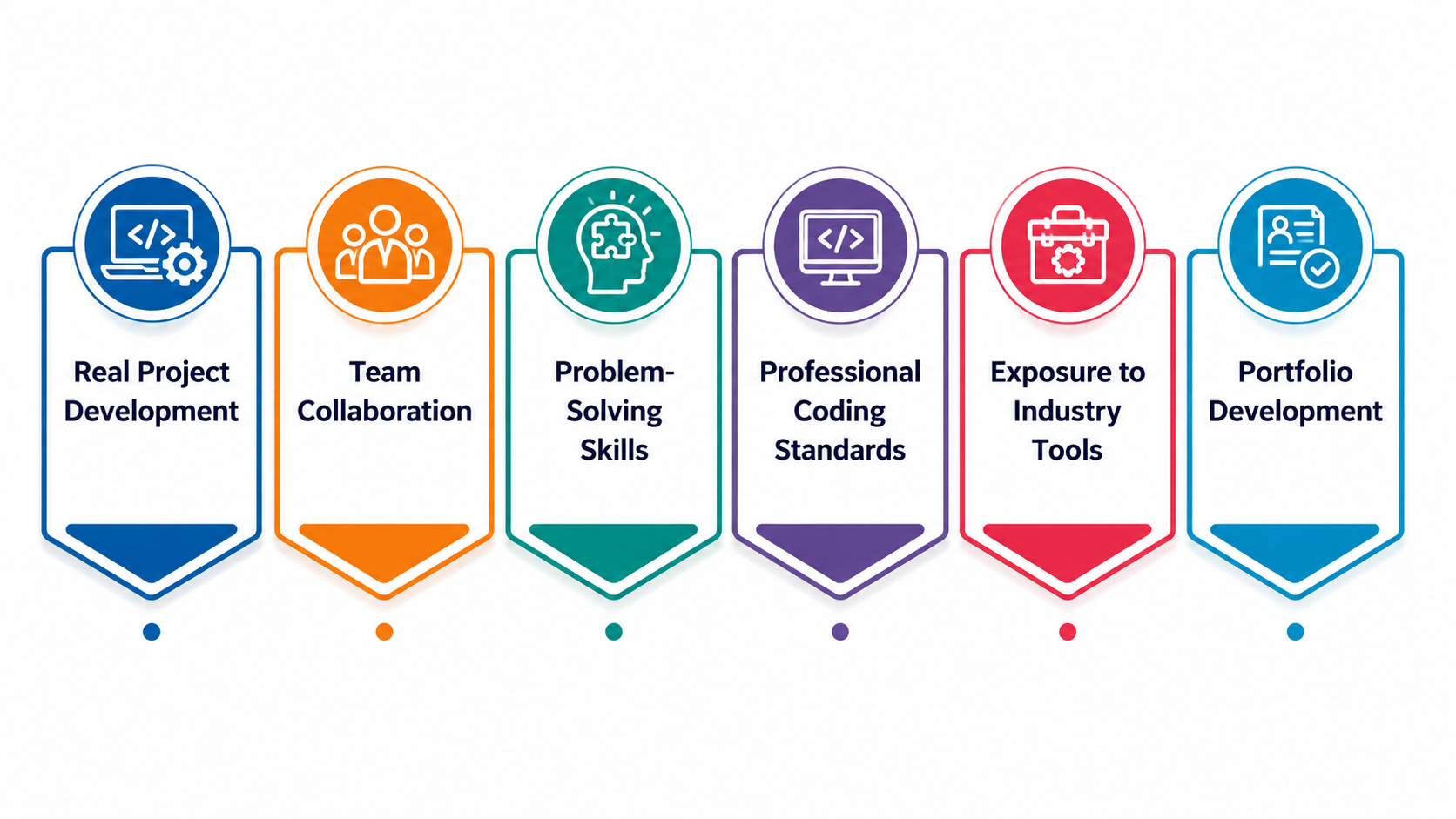
1. Real Project Development
Industrial training allows students to work on real-world AI applications instead of solving only theoretical exercises. They gain practical experience in building machine learning models, AI chatbots, recommendation systems, predictive analytics solutions, and other intelligent applications. This hands-on exposure helps them understand how AI is implemented to solve actual business challenges.
2. Team Collaboration
Modern AI development is rarely an individual effort. During industrial training in Mohali, students collaborate with mentors, developers, designers, and testers while following Agile development practices. They learn to use version control systems like Git, participate in code reviews, manage project tasks, and communicate effectively.
3. Problem-Solving Skills
Real-world AI projects often involve incomplete datasets, unexpected errors, model performance issues, and integration challenges. Industrial training teaches students how to analyze problems, debug applications, optimize AI models, and develop practical solutions.
4. Professional Coding Standards
Writing functional code is important, but writing clean, maintainable, and scalable code is equally essential in the software industry. Industrial training introduces students to coding best practices, proper documentation, testing methodologies, version control, and deployment strategies.
5. Exposure to Industry Tools
Practical training provides hands-on experience with widely used AI technologies such as Python, TensorFlow, PyTorch, Scikit-learn, OpenCV, Docker, GitHub, cloud platforms, and AI APIs. Learning these tools prepares students to work efficiently in modern AI development environments and makes them more competitive in the job market.
6. Portfolio Development
One of the biggest advantages of industrial training in Chandigarh and Mohali is the opportunity to build a strong portfolio of AI projects. Employers often evaluate practical work during interviews, and showcasing real applications on platforms like GitHub demonstrates technical expertise, creativity, and the ability to solve real-world problems.
Essential Skills You Learn During AI Industrial Training
Artificial Intelligence is a multidisciplinary field that combines programming, mathematics, data analysis, and software engineering to build intelligent systems capable of solving complex problems.
1. Programming Fundamentals
Programming forms the backbone of every AI application. During industrial training, students build a strong foundation in programming languages, primarily Python, which is widely used for AI and machine learning development. A solid understanding of programming fundamentals enables students to write clean, efficient, and scalable code.
2. Mathematics and Statistics for AI
Artificial Intelligence relies heavily on mathematical principles. Industrial training helps students understand the concepts that power AI algorithms, including linear algebra, probability, statistics, calculus, vectors, matrices, and optimization techniques. While these topics may seem challenging initially, they are essential for understanding how machine learning models work, improving prediction accuracy, and optimizing AI systems.
3. Machine Learning
Machine Learning is one of the core components of Artificial Intelligence. Students learn how machines identify patterns in data and make predictions without being explicitly programmed. Students also build practical machine learning models using real-world datasets, helping them understand the complete model development process.
4. Deep Learning
Deep Learning enables AI systems to solve highly complex problems such as image recognition, speech processing, and natural language understanding. During ai course in Mohali, students learn about artificial neural networks, convolutional neural networks (CNNs), recurrent neural networks (RNNs), transformers, transfer learning, and model optimization techniques.
5. Data Collection and Preprocessing
High-quality data is the foundation of every successful AI model. Industrial training teaches students how to collect, clean, organize, and preprocess datasets before training machine learning models. They learn techniques such as handling missing values, removing duplicate records, feature scaling, data transformation, data visualization, and exploratory data analysis (EDA).
6. Natural Language Processing
Natural Language Processing enables computers to understand, interpret, and generate human language. AI Industrial Training introduces students to NLP concepts through practical applications such as AI chatbots, sentiment analysis, text classification, language translation, document summarization, keyword extraction, and conversational AI systems.
7. Computer Vision
Computer Vision focuses on enabling machines to interpret visual information from images and videos. Students learn how to build applications for facial recognition, object detection, image classification, medical image analysis, OCR (Optical Character Recognition), surveillance systems, and quality inspection.
Career Opportunities After AI Industrial Training
Artificial Intelligence is transforming the way businesses operate, creating exciting career opportunities across almost every industry. Below are some of the most promising career opportunities after AI Industrial Training:
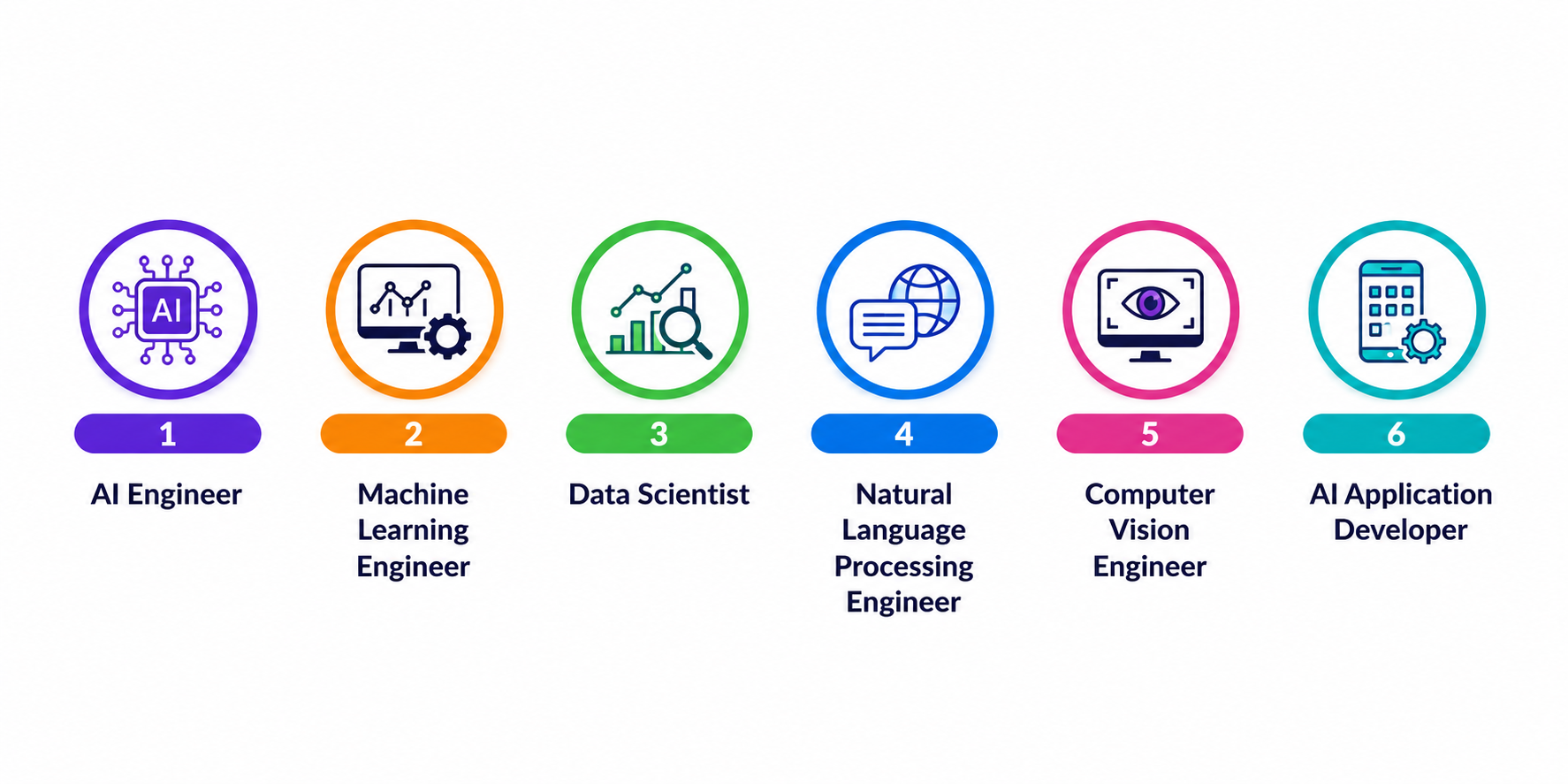
1. AI Engineer
AI Engineers design, build, and deploy intelligent systems that automate tasks and improve business operations. They combine machine learning, deep learning, and software engineering principles to develop AI-powered applications such as virtual assistants, recommendation engines, predictive analytics platforms, and automation tools. This role requires strong programming skills, mathematical knowledge, and experience with AI frameworks.
2. Machine Learning Engineer
Machine Learning Engineers focus on developing algorithms that enable systems to learn from data and improve over time. They build predictive models, recommendation systems, fraud detection solutions, and customer behavior analysis tools.
3. Data Scientist
Data Scientists analyze large volumes of structured and unstructured data to uncover valuable business insights. Using statistical methods, machine learning algorithms, and data visualization techniques, they help organizations make data-driven decisions.
4. Natural Language Processing Engineer
NLP Engineers develop AI systems capable of understanding, interpreting, and generating human language. They work on applications such as AI chatbots, virtual assistants, language translation tools, sentiment analysis platforms, speech recognition systems, and intelligent document processing solutions.
5. Computer Vision Engineer
Computer Vision Engineers create AI applications that analyze and interpret images and videos. They develop technologies for facial recognition, object detection, medical image analysis, quality inspection, autonomous vehicles, and surveillance systems. This role combines deep learning techniques with image processing technologies to solve real-world visual recognition problems.
6. AI Application Developer
AI Application Developers integrate Artificial Intelligence capabilities into web and mobile applications. They build intelligent features such as personalized recommendations, voice assistants, smart search, facial recognition, predictive analytics, and chatbot integrations.
How AI Complements Web and Mobile Development
Modern applications increasingly rely on AI-powered features. Developers who understand AI can build:
- Smart mobile applications
- AI-powered websites
- Recommendation engines
- Voice assistants
- Image recognition apps
- Intelligent search systems
- Predictive dashboards
- Customer support automation
Students pursuing Web app development Training in Mohali often benefit from AI integration skills, allowing them to create intelligent web applications that deliver personalized user experiences and advanced automation capabilities.
Similarly, students enrolled in app development Training in Mohali can enhance mobile applications with AI features such as facial recognition, speech processing, virtual assistants, and predictive recommendations, making their applications more innovative and competitive.
How to Choose the Right AI Industrial Training
Choosing the right artificial intelligence Industrial Training in Mohali is one of the most important decisions for anyone planning to build a successful career in Artificial Intelligence. With numerous training providers available, it's essential to select one that focuses on practical learning, industry exposure, and real-world project experience rather than just theoretical concepts.
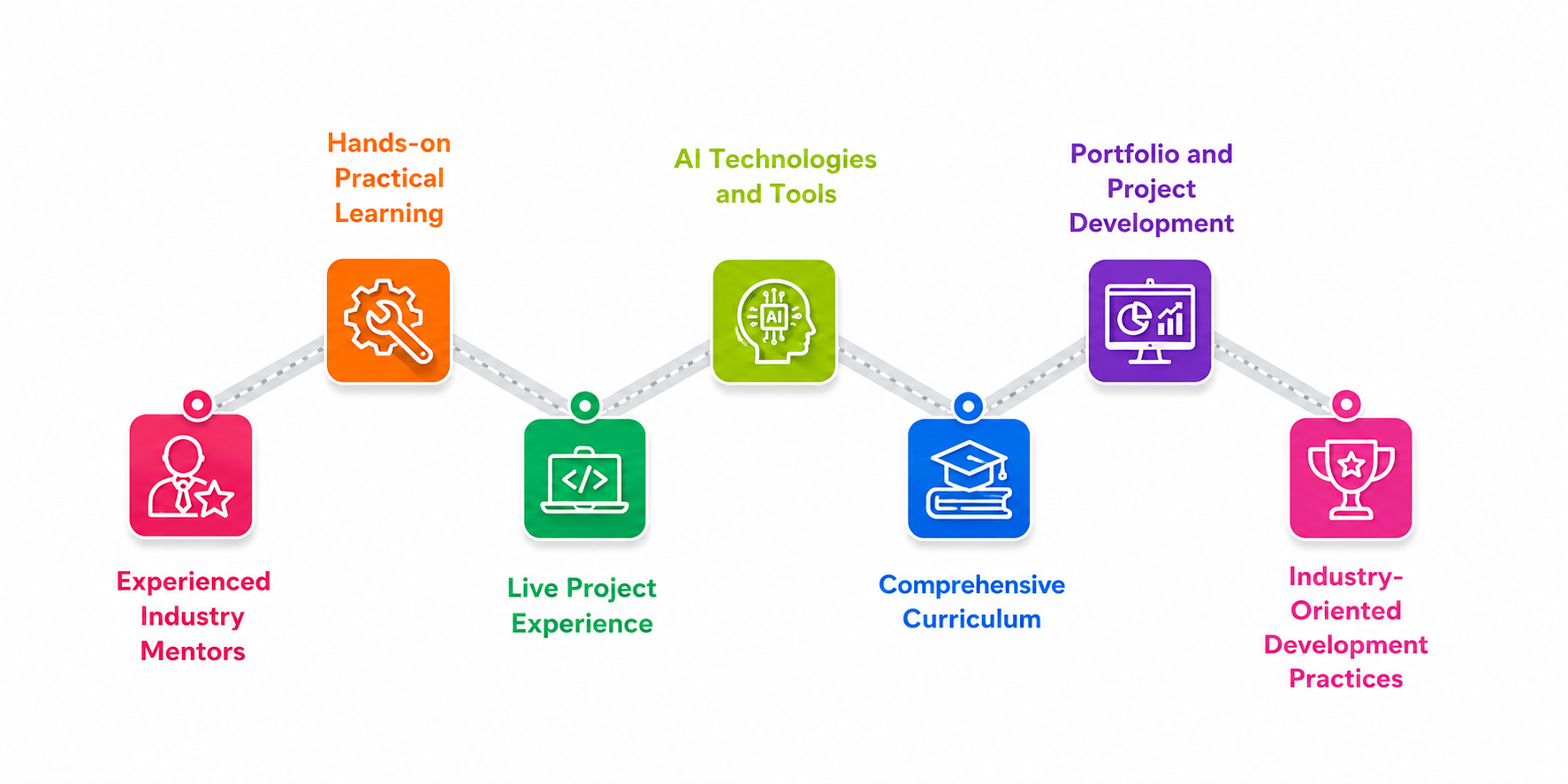
1. Experienced Industry Mentors
Learning from professionals who actively work on AI projects provides valuable insights into current industry practices and emerging technologies. Experienced mentors can explain complex concepts in a practical way, guide students through real-world challenges, conduct code reviews, and share best practices that cannot be learned from textbooks alone.
2. Hands-on Practical Learning
Artificial Intelligence is a skill-based field that requires continuous practice. Choose a training program that emphasizes hands-on learning through coding exercises, AI model development, data analysis, and real-world problem-solving. Practical implementation allows students to understand how AI concepts work in actual business scenarios and prepares them for professional development environments.
3. Live Project Experience
One of the biggest advantages of industrial training is the opportunity to work on live or industry-oriented projects. Real-world projects expose students to complete software development workflows, including requirement analysis, data preparation, model development, testing, deployment, and maintenance.
4. AI Technologies and Tools
Artificial Intelligence evolves rapidly, making it essential to learn the latest technologies used by the industry. A quality training program should cover modern tools and frameworks such as Python, TensorFlow, PyTorch, Scikit-learn, OpenCV, Pandas, NumPy, Hugging Face, LangChain, Git, Docker, cloud platforms, and Generative AI technologies.
5. Comprehensive Curriculum
A strong AI Industrial Training program should provide balanced coverage of both foundational and advanced topics. It should include programming fundamentals, mathematics for AI, machine learning, deep learning, natural language processing (NLP), computer vision, data preprocessing, model optimization, API integration, cloud deployment, and AI application development.
6. Portfolio and Project Development
Employers often evaluate candidates based on the projects they have completed rather than certificates alone. Choose a training program that encourages students to build multiple AI applications and maintain a professional portfolio on platforms like GitHub. A strong project portfolio demonstrates practical expertise, creativity, and the ability to solve real-world business problems, making candidates more attractive to recruiters.
7. Industry-Oriented Development Practices
Professional software development involves much more than writing code. The training program should introduce students to Agile methodologies, version control systems like Git, collaborative development, code reviews, documentation, software testing, debugging techniques, and deployment processes.
Conclusion
Artificial Intelligence is no longer a niche technology, it has become an essential driver of innovation across virtually every industry. Building a successful AI career requires more than understanding algorithms and programming concepts. Employers increasingly seek professionals who can solve real business challenges, develop intelligent applications, collaborate within development teams, and deliver production-ready AI solutions.
At ToXSL Technologies, we are committed to empowering aspiring AI professionals through hands-on industrial training, real-world project exposure, and mentorship from experienced developers. Our goal is to help students build practical skills, stay updated with emerging AI technologies, and prepare for rewarding careers in the ever-evolving world of Artificial Intelligence. With the right guidance and continuous learning, today's students can become tomorrow's AI innovators. Enroll today.
Frequently Asked Questions
1. What is AI Industrial Training?
AI Industrial Training is a practical learning program that helps students gain hands-on experience in Artificial Intelligence by working on real-world projects, industry tools, machine learning models, and AI application development.
2. What is the duration of AI Industrial Training programs?
AI Industrial Training is available in flexible durations of 45 days, 3 months, and 6 months. Students can choose the program based on their learning goals, academic requirements, and career aspirations while gaining practical, industry-focused AI development experience.
3. Who can join AI Industrial Training?
Students pursuing engineering, computer science, information technology, software development, data science, or any graduates interested in Artificial Intelligence can benefit from AI Industrial Training. Basic programming knowledge, especially in Python, is an added advantage but not always mandatory.
4. What skills can I learn during AI Industrial Training?
You can learn Python programming, Machine Learning, Deep Learning, Natural Language Processing, Computer Vision, Data Analysis, AI model deployment, Git, cloud integration, API development, and practical software development methodologies through hands-on projects.
5. How does AI Industrial Training improve job opportunities?
Industrial training equips students with practical project experience, portfolio development, technical problem-solving abilities, teamwork, and exposure to industry-standard tools, making them more attractive to recruiters and improving their chances of securing AI-related roles.
6. Why is practical AI experience important for students?
Practical experience helps students apply theoretical concepts to real-world problems, understand industry workflows, build confidence, develop production-ready applications, and prepare effectively for technical interviews and future AI careers.